Hybrid Work
June 10, 2023
Hybrid work is, arguably, the worst scenario that could be imposed on software developers — not because it is inherently flawed, but because it was invented by managers for managers.
Managers thrive on information that comes from countless informal channels. Coffee-point conversations, hallway encounters, lunch chats — every interaction is a valuable data source. Their day is built around constant communication: running between meeting rooms, checking email nonstop, messaging people continuously. This is their job. It is important, but it is nothing like the job developers do.
In the brilliant book Managing Humans, there is a concept known as "The Cave." It refers to a developer's sanctuary — a meticulously optimized personal space where productivity reaches its peak. Two monitors positioned just right, a perfectly adjusted chair, a favorite mug placed on a familiar coaster, a mechanical keyboard, tiny duck figurines on the desk — whatever makes the space yours. When a developer enters this space and follows a habitual ritual — perhaps a first sip of coffee and a quick scan of email — focus deepens and creation begins.
Hybrid work breaks this system in several ways.
1. The Cave Exists at Home — But Hybrid Work Forces You Out of It
In a hybrid setup, the workspace that truly supports productivity is the one at home. That is where "The Cave" exists — the carefully crafted environment optimized for deep work. But on the days when hybrid schedules demand going to the office, that space is left behind. And in the office, there is rarely a permanent desk. Every visit becomes a reset: fighting for the same spot, giving up external monitors, adjusting the chair again, and leaving the favorite mug behind.
The ritual is broken before work even starts — and when the ritual breaks, productivity drops.
2. Modern Offices Are Mostly Open-Space
Thinking deeply in a noisy open-space environment is a challenge. Noise-canceling headphones do help, but then why are we in the office if the goal is to block out colleagues and pretend they aren't there? At that point, home would be a far better option.
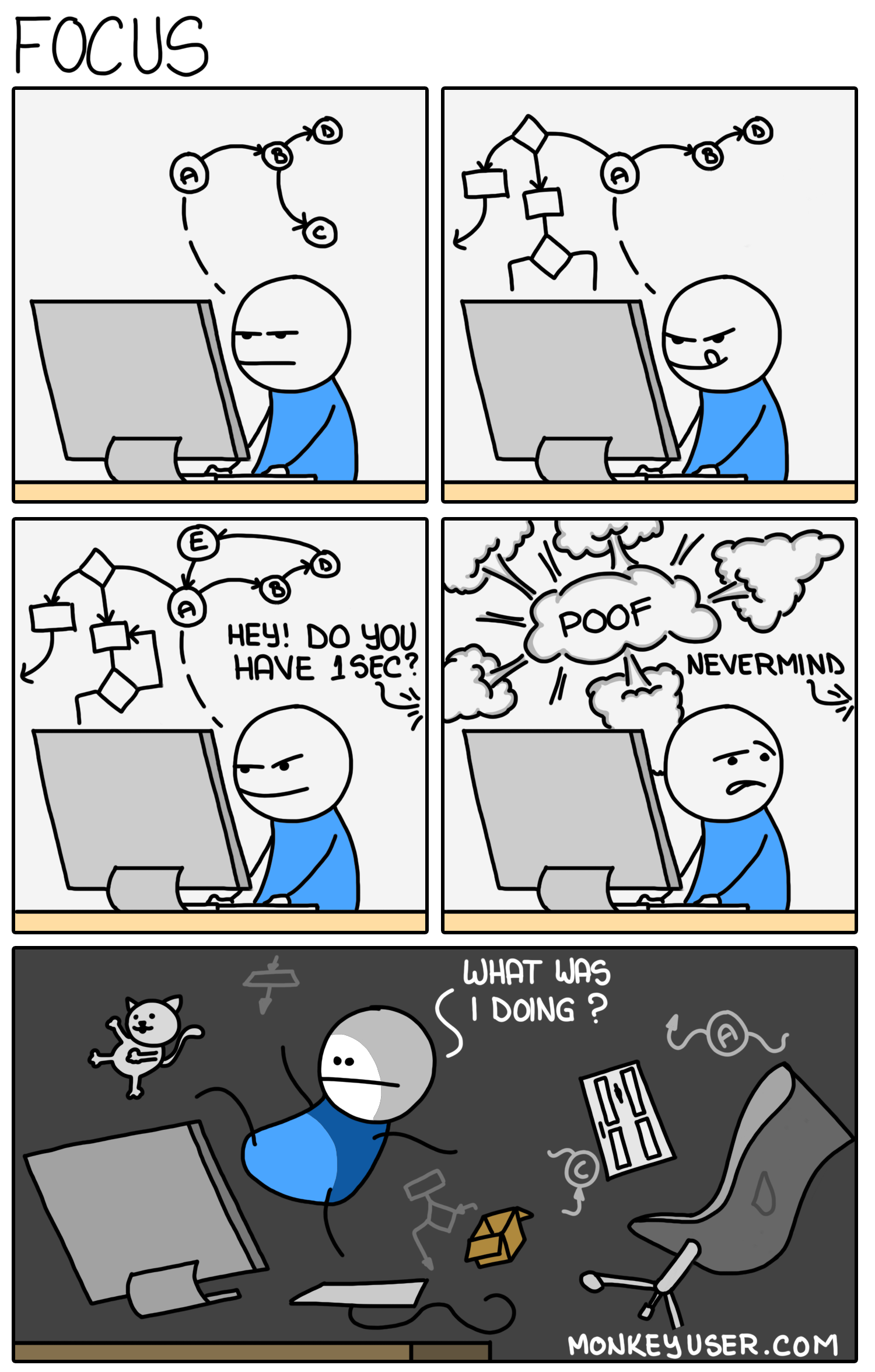
Again — a drop in productivity.
3. The Commute
The pandemic showed us that distributed living is possible — and that it doesn't make sense to waste hours commuting when that time could be spent far more productively. Yet hybrid work brings the commute back into our lives, often at a significant cost in time and energy.
Hybrid work might serve managerial interests — easier oversight, spontaneous conversations, constant communication. But for developers, whose productivity depends on deep focus and a personalized environment, hybrid work often means fragmentation, disruption, and unnecessary friction.
The result? Less focus. Less flow. Less creation.
For developers, the best work happens in the Cave — and hybrid work keeps pushing them out of it.